The $3 million Navy effort is in
addition to the $60 million refitting cost, White said.
"The Navy is footing the bill; however, Intrepid will
make its best effort to reimburse the Navy for the
cost," he said.Officials had planned for a
combination of federal, state, city and private funds to
cover the $60 million.
The operation to free the ship will take place over
the next several weeks, but the Navy and its contractors
have not set a towing date, White said.
"The expertise that the military is offering to solve
this situation is crucial to allowing Intrepid to get
under way and for us to stay within our schedule to
refurbish the ship and rebuild Pier 86," said Arnold
Fisher, chairman of the museum.
Pat Dolan, spokeswoman for the Naval Sea Systems
Command, said the Navy was "pleased to be providing
assistance."
The Intrepid was deployed in 1943 and became a
mainstay of the war against Japan in the Pacific,
surviving five kamikaze attacks, seven bombs and a
torpedo hit. A total of 270 crew members were killed.
It also served in the Vietnam and Korean wars and was
a recovery ship for NASA astronauts in the early days of
the space program.
Intrepid was saved from the scrap yard in the 1970s
by New York builder Zach Fisher. Since then, with
military aircraft displayed on its flight deck and in
the hangar deck, it has been serving as a memorial to
the armed services, drawing more than 700,000 visitors a
year.
It is also equipped to serve as an emergency
operations center for city and federal authorities, and
the FBI used it as a base of operations after the 2001
terrorist attacks.
The carrier's refurbishment is to include the opening
of more interior spaces to the public and upgrading of
exhibits.
|
December 6, 2006
The second attempt to move the USS Intrepid from its Hudson River pier proved to be as much a nail-biter as the first a month ago, but the outcome this time was positive.
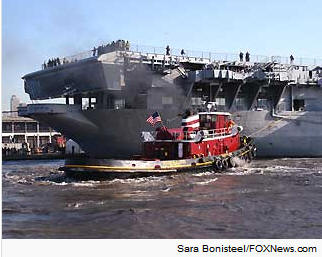
Four high-powered tugboats, managed to move the aircraft carrier 8 feet back and about 5 feet out from the dock before it got stuck in the mud, which also happened on Nov. 6. But then after a struggle of more than 30 minutes, the tugs yanked the 29,000-ton famed ship from Pier 86, where it had been docked for 24 years.
As the vessel was wiggled free of mud that clung to its propellers and began to clear the end of the pier, Bill White, president of the Intrepid Sea, Air & Space Museum, urged the 920-foot vessel on.
"Come on, baby! Come on, baby!," he shouted. "We'll see you in Bayonne," he yelled to employees watching from the pier, referring to the intended destination five miles down the river and across the harbor in New Jersey where the Intrepid will begin a two-year overhaul. When the ship was finally out in the river, White and tug coordinator Capt. Pat Kinnier began jumping up and down, whooping and giving each other high fives.
"We're excited," White said. "It's a great day."
The same six tugs from the McAllister Towing and Transportation Co. of Manhattan with almost 30,000 combined horsepower that had attempted to budge the ship on Nov. 6. began arriving before daylight Tuesday.
This time three tugs tried to back the ship out a slight angle rather than straight back as on Nov. 6. But despite the dredging of an additional 39,000 cubic yards of mud from around the ship, the same problem surfaced: Kinnier said the propellers were pushing up a mound of mud that stopped the ship.
"We've got to break these screws out of the mud," he said.
When the Intrepid refused to budge after the initital shift, Kinnier and White looked at each other with grim faces and White asked if more tugs could be called in.
"I was very worried," White said later.
But then McAllister executives shifted one tug -- the Robert E. McAllister -- to the port quarter to wiggle the stern back and forth and then help pull backwards. That worked.
On board for the high publicized trip were 20 former crew members, including Marino DiLeo, 70, of Bay Shore. He served on board in 1956 after the Korean War.
Getting the Intrepid moving again was a relief for DiLeo.
"I'm glad because I'm tired of getting calls about, 'Hey, stuck in the mud,'" DiLeo said. "It's gotta go; they called in the Navy and they got the job done." The Navy had arranged for the additional dredging at a cost of $3 million.
DiLeo has volunteered on the ship for a dozen years. This is a special time of the year for him -- during the holidays, he plays Santa Claus for children.
His roles were different back then. A former helicopter pilot, DiLeo described life on the Intrepid as quick-paced.
"It was busy," he said. "People don't realize how active and dangerous the flight deck of a carrier is."
The ship made a symbolic stop at Ground Zero, where 16 of the former crewmen unfurled a 50-by-90-foot American flag. Like the move itself, it proved difficult, with the flag refusing to fully unfold. The vets and cadets from SUNY Maritime College pulled it back up and managed to get it to cooperate on the second try. Then their hats off, the veterans lined the rail of the ship facing Manhattan and paused for a moment of silence.
Sixteen cadets and their staff officers from SUNY Maritime College at Fort Schuyler in the Bronx were aboard to help with the docklines.
"I'm ecstatic," said Andrew Maksimowicz, 19, of Wantagh, a first-year student. "I grew up on boats on the South Shore. The chance to work on a big ship like this is mind-boggling."
Lt. Commander Tom Spinia, a staff member, said the school participated because it had a long-standing relationship with McAllister. "This fits in, obviously, with our training," he said.
After pausing for more than an hour in the harbor to wait for a favorable tide change, the Intrepid docked in Bayonne at 3:40 p.m.
The 29,000-ton Intrepid required almost 29 feet of water to float after 600 tons of water ballast was removed for the first attempt. Matt Woods, the museum vice president for operations, said that with the extra dredging there was more than 2 feet of water between the ship's keel and the mud at high tide Tuesday when the tugs began pulling.
|