|
He meant so much to the millions of Americans who fought in World War
II, and to those who had waited for them to come home. He was a kid
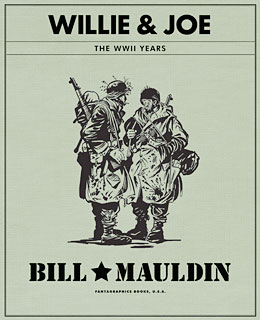
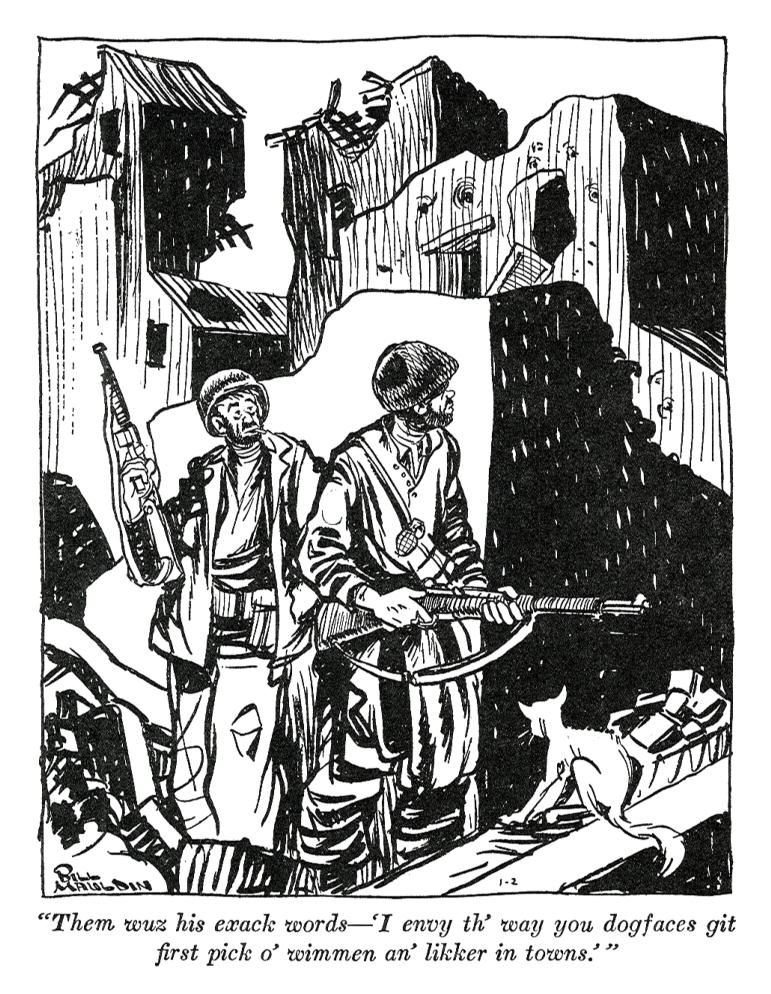
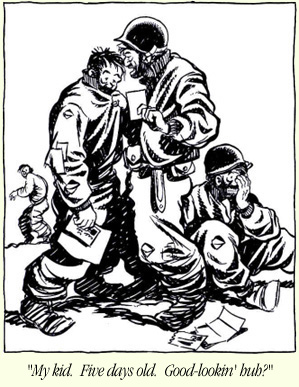
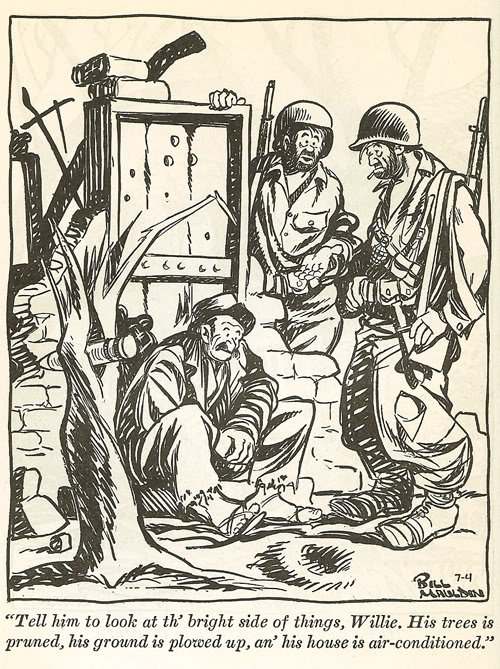
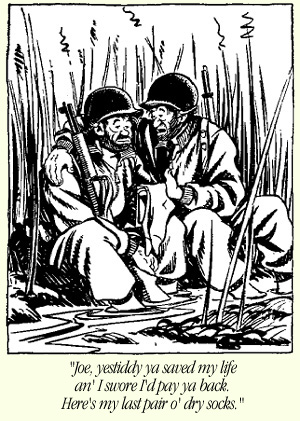
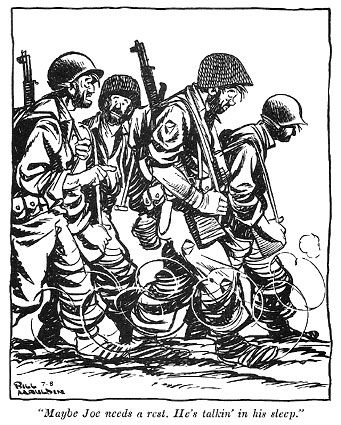
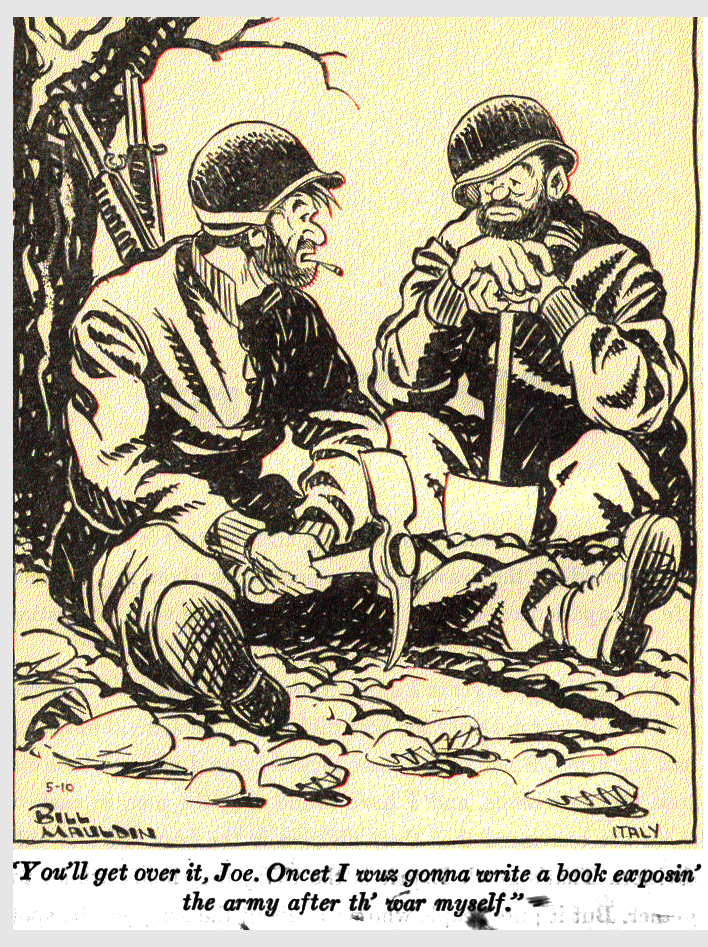
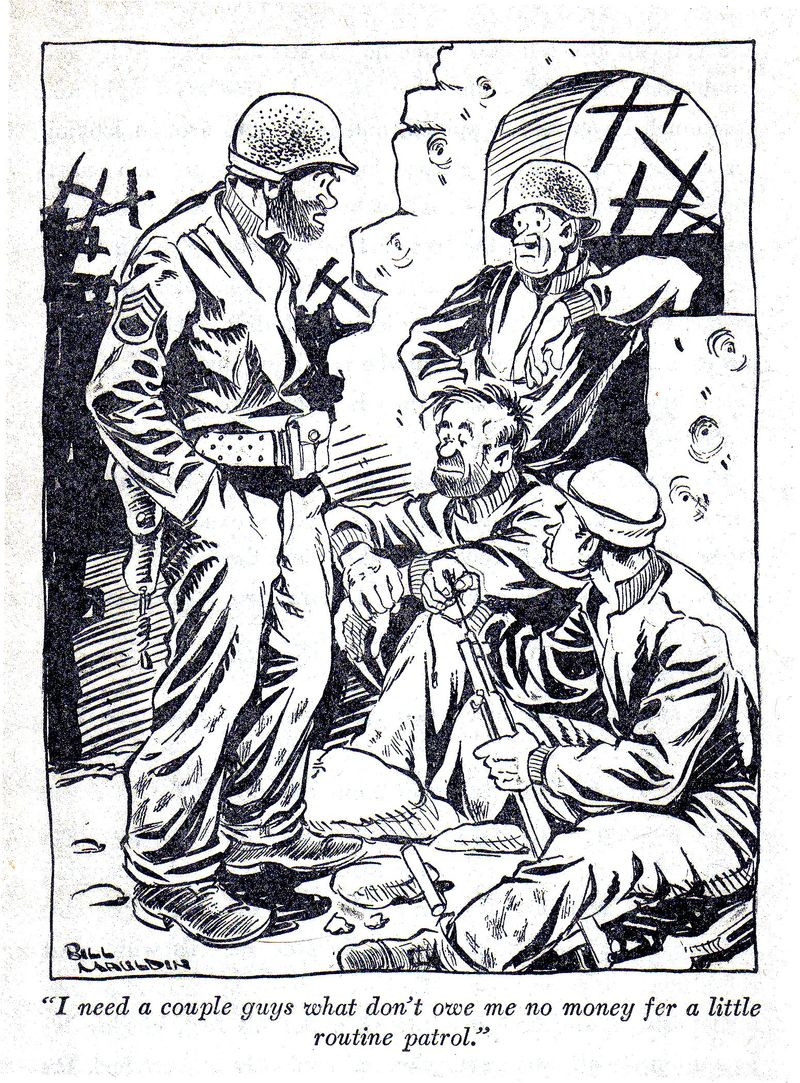
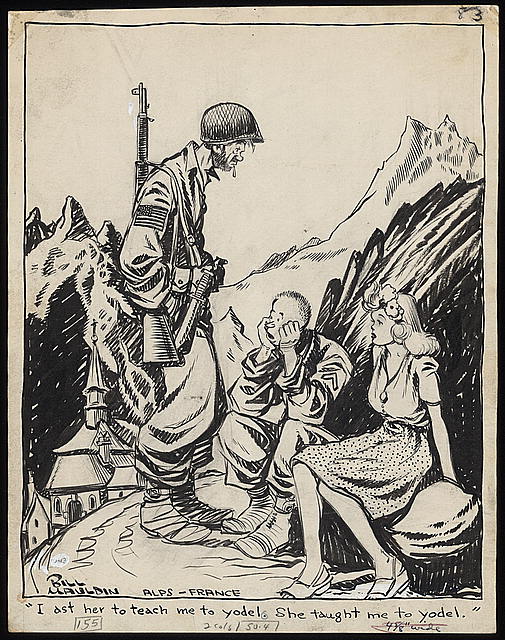
cartoonist for Stars and Stripes, the military newspaper; Mauldin's
drawings of his muddy, exhausted, whisker-stubble infantrymen Willie and
Joe were the voice of truth about what it was like on the front lines.
Mauldin was an enlisted man just like the soldiers for whom he drew; his
gripes were their gripes, his laughs their laughs, his heartaches their
heartaches. He was one of them. They loved him.
He never held back. Sometimes, when his cartoons cut too close for
comfort, superior officers tried to tone him down. In one memorable
incident, he enraged Gen. George S. Patton, who informed Mauldin he
wanted the pointed cartoons celebrating the fighting men, lampooning the
high-ranking officers to stop. Now!
The news passed from soldier to soldier. How was Sgt. Bill Mauldin going
to stand up to Gen. Patton? It seemed impossible.
Not quite. Mauldin, it turned out, had an ardent fan: Five-star Gen.
Dwight D. Eisenhower, SCAFE, Supreme Commander of the Allied Forces in
Europe. Ike put out the word: "Mauldin draws what Mauldin wants."
Mauldin won. Patton lost.
If, in your line of work, you've ever considered yourself a young
hotshot, or if you've ever known anyone who has felt that way about him
or herself, the story of Mauldin's young manhood will humble you. Here
is what, by the time he was 23 years old, Mauldin had accomplished:+
He won the Pulitzer Prize & was on the cover of Time magazine. His book
"Up Front" was the No. 1 best-seller in the United States.
All of that at 23. Yet, when he returned to civilian life and grew
older, he never lost that boyish Mauldin grin, never outgrew his
excitement about doing his job, never big-shotted or high-hatted the
people with whom he worked every day.
I was lucky enough to be one of them. Mauldin roamed the hallways of the
Chicago Sun-Times in the late 1960s and early 1970s with no more
officiousness or air of haughtiness than if he was a copyboy. That impish look on his
face remained.
He had achieved so much. He won a second Pulitzer Prize, and he should
have won a third for what may be the single greatest editorial cartoon
in the history of the craft: his deadline rendering, on the day
President John F. Kennedy was assassinated, of the statue at the Lincoln
Memorial, slumped in grief, its head cradled in its hands. But he never
acted as if he was better than the people he met. He was still Mauldin,
the enlisted man.

During the late summer of 2002, as Mauldin lay in that California
nursing home, some of the old World War II infantry guys caught wind of
it. They didn't want Mauldin to go out that way. They thought he should
know he was still their hero.
Gordon Dillow, a columnist for the Orange County Register, put out the
call in Southern California for people in the area to send their best
wishes to Mauldin. I joined Dillow in the effort, helping to spread the
appeal nationally, so Bill would not feel so alone. Soon, more than
10,000 cards and letters had arrived at Mauldin's bedside.
Better
than that, old soldiers began to show up just to sit with Mauldin, to
let him know that they were there for him, as he, so long ago, had been
there for them. So many volunteered to visit Bill that there was a
waiting list. Here is how Todd DePastino, in the first paragraph of his
wonderful biography of Mauldin, described it:
"Almost every day
in the summer and fall of 2002, they came to Park Superior nursing home
in NewportBeach, California, to honor Army Sergeant, Technician Third
Grade, Bill Mauldin. They came bearing relics of their youth: medals,
insignia, photographs, and carefully folded newspaper clippings. Some
wore old garrison caps. Others arrived resplendent in uniforms over a half century old. Almost all of them wept as they filed
down the corridor like pilgrims fulfilling some long-neglected
obligation."
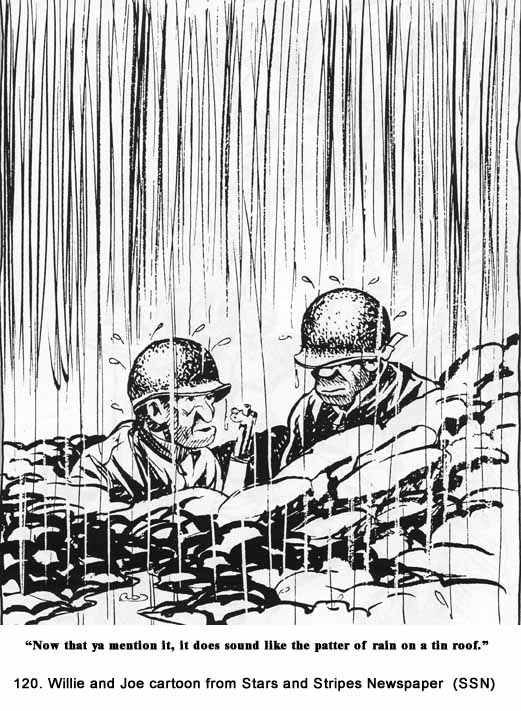
One of the veterans explained to me why it was so important: "You would
have to be part of a combat infantry unit to appreciate what moments of
relief Bill gave us. You had to be reading a soaking wet Stars and
Stripes in a water-filled foxhole and then see one of his cartoons."
Mauldin is buried in Arlington National Cemetery. Last month, the kid
cartoonist made it onto a first-class postage stamp. It's an honor that
most generals and admirals never receive.
What Mauldin would have loved most, I believe, is the sight of the two
guys who keep him company on that stamp.
Take a look at it.
There's Willie. There's Joe.
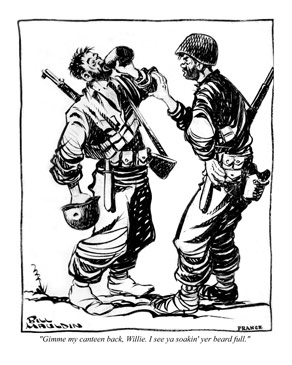
And there, to the side, drawing them and smiling that shy, quietly
observant smile, is Mauldin himself. With his buddies, right where he
belongs. Forever.
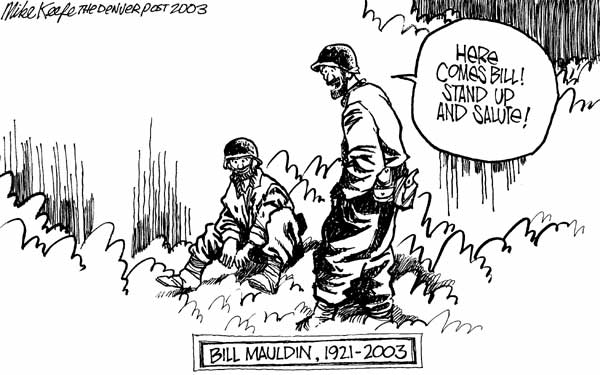
What a story, and a fitting tribute to a man and to a time that few of
us can still remember.
|
